
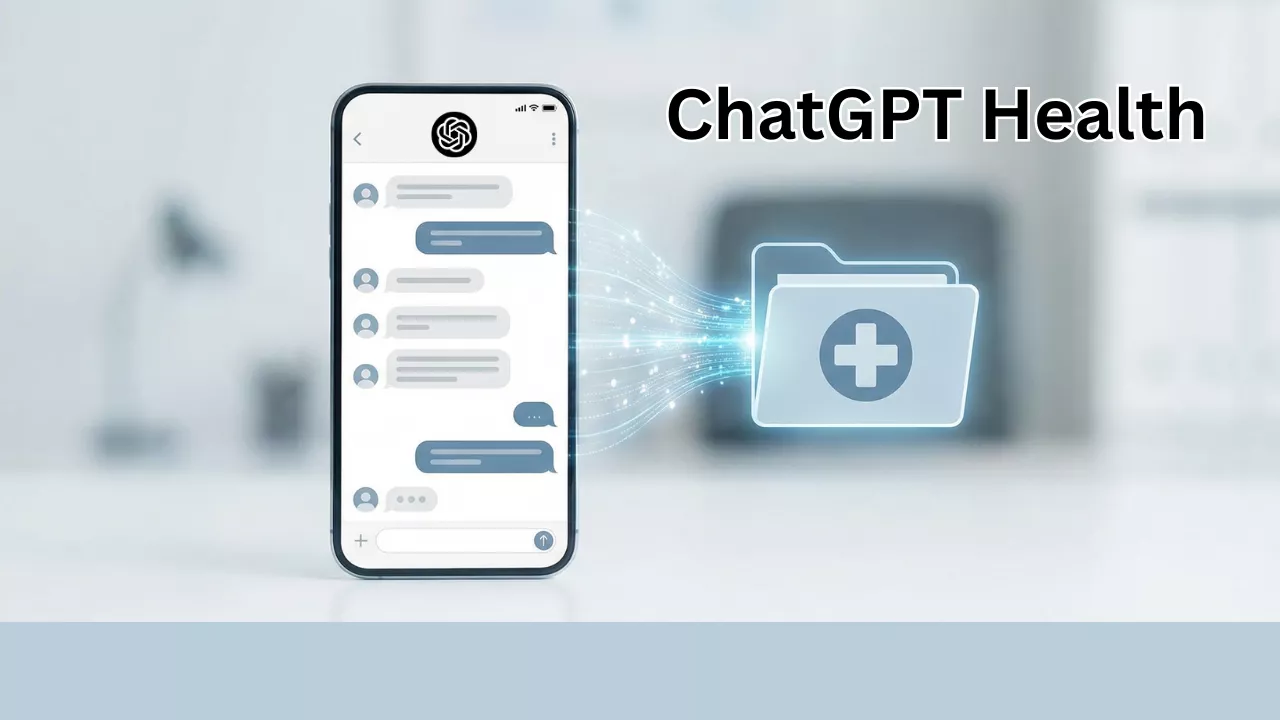
OpenAI just made healthcare personal with ChatGPT Health, a new feature that lets you connect your medical records, Apple Health data, and wellness apps directly to ChatGPT. The company announced this week that the feature is rolling out to early users, with wider access coming in the next few weeks.
What ChatGPT Health Actually Does
Think of it as a separate health assistant living inside ChatGPT. You can connect apps like Apple Health, MyFitnessPal, Weight Watchers, and even your actual medical records through a partnership with b.well, a health data connectivity company. Once connected, you can ask ChatGPT to help you understand recent lab results, prepare questions for your doctor, or figure out how your fitness routine aligns with your health goals.
The feature lives in its own tab, completely separate from your regular ChatGPT conversations. OpenAI says health data stays in that space and won’t leak into your other chats. They’ve also promised that these conversations won’t be used to train their AI models.
More than 230 million people already ask ChatGPT health questions every week, according to OpenAI. That’s roughly one in four of their 800 million weekly users. The company has been watching this trend for two years and decided to build something specifically for it.
Why OpenAI Built This Now
OpenAI’s CEO of applications, Fidji Simo, shared a personal story about why this matters. She was hospitalized for a kidney stone last year and developed an infection. A resident prescribed a standard antibiotic, but when she checked it against her medical history in ChatGPT, it flagged a problem. The medication could have reactivated a serious infection she had years earlier. The resident was grateful she spoke up.
This is the use case OpenAI is betting on. Not replacing doctors, but helping you navigate a complicated healthcare system where doctors have just a few minutes per patient and medical records are scattered across different portals and apps.
The company worked with over 260 physicians across 60 countries over the past two years. These doctors reviewed AI responses more than 600,000 times across 30 different health topics. They helped train the model to explain lab values clearly, flag warning signs that need urgent care, and summarize care instructions.
The Privacy Question Everyone’s Asking
Here’s where things get interesting. ChatGPT Health is not HIPAA compliant. That’s the federal law that protects your medical information when you share it with doctors and hospitals. Consumer health apps don’t fall under HIPAA, and OpenAI isn’t classified as a healthcare provider.
OpenAI says they’ve added extra security layers like purpose-built encryption, isolation of health data, and multi-factor authentication options. Medical records stay separate from your other data. You can delete health memories anytime you want.
But experts are cautious. Bradley Malin, a professor at Vanderbilt University Medical Center, told TIME that when you provide data to a technology company not providing healthcare services, it’s buyer beware. If there’s a data breach, you don’t have HIPAA protections. You’d need to rely on the FTC or sue the company directly.
There’s also the technical reality that AI models are designed to be helpful, not necessarily medically accurate. A recent study found that these models prioritize giving you an answer you’ll like rather than the most accurate medical information. They can also hallucinate make up information that sounds right but isn’t.
Who Can Use It Right Now
The rollout is limited for now. OpenAI is starting with a small group of early users who can join a waitlist. If you’re in the European Economic Area, Switzerland, or the UK, you’re out of luck those regions have stricter data privacy laws, and OpenAI isn’t launching there yet.
Medical record integrations and some apps are US-only. Connecting Apple Health requires iOS. OpenAI plans to expand to all users on web and iOS in the coming weeks.
What Makes This Different
As per my observation, OpenAI is positioning itself as the new interface between you and basically everything shopping, finance, education, and now healthcare.
They’re not trying to become a medical device or diagnostic tool. They’re trying to become the layer you use to understand and interact with all your health information. That’s a much bigger play than just “AI helps you read lab results.”
The real test isn’t whether ChatGPT can explain what your cholesterol numbers mean. Anyone can Google that. The real test is whether people trust OpenAI enough to hand over their most sensitive personal data medical histories, prescriptions, genetic information, mental health records to a for-profit AI company with no HIPAA obligations.
Right now, 40 million people are already asking ChatGPT about health every day. If even a fraction of them connect their medical records, OpenAI will have access to one of the largest personal health datasets in the world. That’s valuable not just for improving their AI, but for positioning themselves as the essential health companion people can’t live without.
Whether that’s exciting or concerning probably depends on how much you trust AI companies with your most private information.

Cody Scott
Cody Scott is a passionate content writer at AISEOToolsHub and an AI News Expert, dedicated to exploring the latest advancements in artificial intelligence. He specializes in providing up-to-date insights on new AI tools and technologies while sharing his personal experiences and practical tips for leveraging AI in content creation and digital marketing