
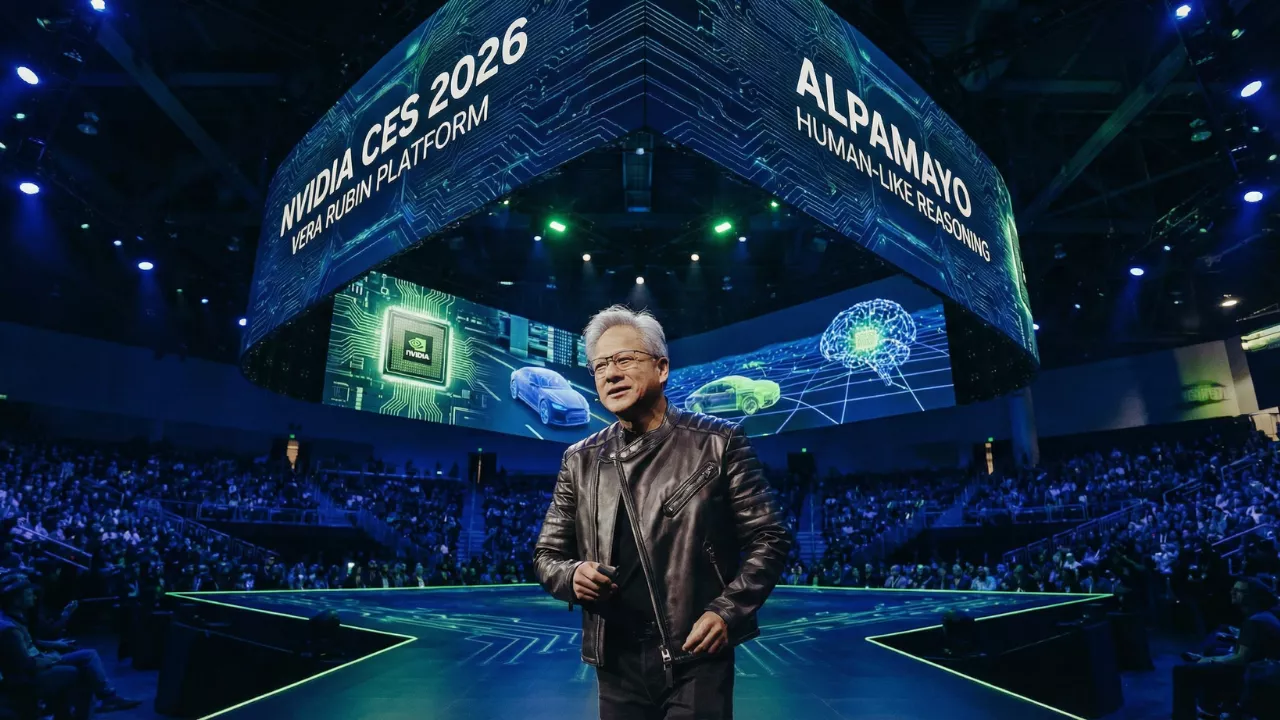
Jensen Huang just lit up CES 2026 in Las Vegas with two massive reveals that could reshape AI infrastructure and autonomous driving forever. The spotlight was on the Vera Rubin platform, NVIDIA’s next-gen AI powerhouse now in full production, and Alpamayo, an open-source family of models that lets cars think through tricky situations like a careful human driver.
What Makes Vera Rubin a Big Deal?
Vera Rubin isn’t just another chip upgrade it’s a full rack-scale system built from six co-designed components working as one supercomputer. We’re talking the Vera CPU with 88 custom Olympus cores, dual Rubin GPUs packing hundreds of billions of transistors, plus advanced networking like NVLink 6 switches and BlueField-4 DPUs.
NVIDIA claims it delivers up to 5x more inference performance than Blackwell, with token costs dropping dramatically potentially 10x cheaper for some workloads. Systems like the NVL72 rack, combining 72 GPUs, start rolling out to partners including AWS, Google Cloud, Microsoft, and CoreWeave in the second half of 2026.
This extreme integration tackles the exploding demands of agentic AI and multi-step reasoning models, making massive training and inference more efficient and secure.
Alpamayo: Teaching Cars to Reason, Not Just React
On the roads, Alpamayo steals the show as NVIDIA’s push into “physical AI.” This open portfolio kicks off with Alpamayo 1, a 10-billion-parameter vision-language-action model using chain-of-thought reasoning.
It breaks down complex scenarios like a broken traffic light in chaos step by step, explains decisions, and picks the safest move. The code’s already on Hugging Face for anyone to build on, and it integrates with NVIDIA’s DRIVE platform.
Big win: The upcoming Mercedes-Benz CLA becomes the first production car with Alpamayo features, hitting roads in Q1 2026. Partners like JLR, Lucid, and Uber are jumping in too.
Why This Feels Like a Turning Point
These launches come as AI shifts from hype to real-world impact, with demands for efficiency and reliability skyrocketing. Vera Rubin keeps NVIDIA ahead in data centers, while Alpamayo could finally crack those stubborn edge cases holding back full autonomy.
Personally, I’m thrilled by the open-source angle on Alpamayo it invites the whole industry to innovate faster, potentially accelerating safer robotaxis and beyond. If NVIDIA nails this execution, 2026 could mark when AI truly starts driving our future, literally and figuratively.