
A Google engineer just shared something that’s getting everyone’s attention in the tech world. Jaana Dogan, who works as a Principal Engineer at Google, posted on X that Anthropic’s Claude Code accomplished in one hour what her entire team struggled with for a year.
What Actually Happened
Dogan’s team at Google has been trying to build distributed agent orchestrators since last year. They tried different approaches, had multiple discussions, but couldn’t settle on the right solution. Then she decided to test Claude Code.
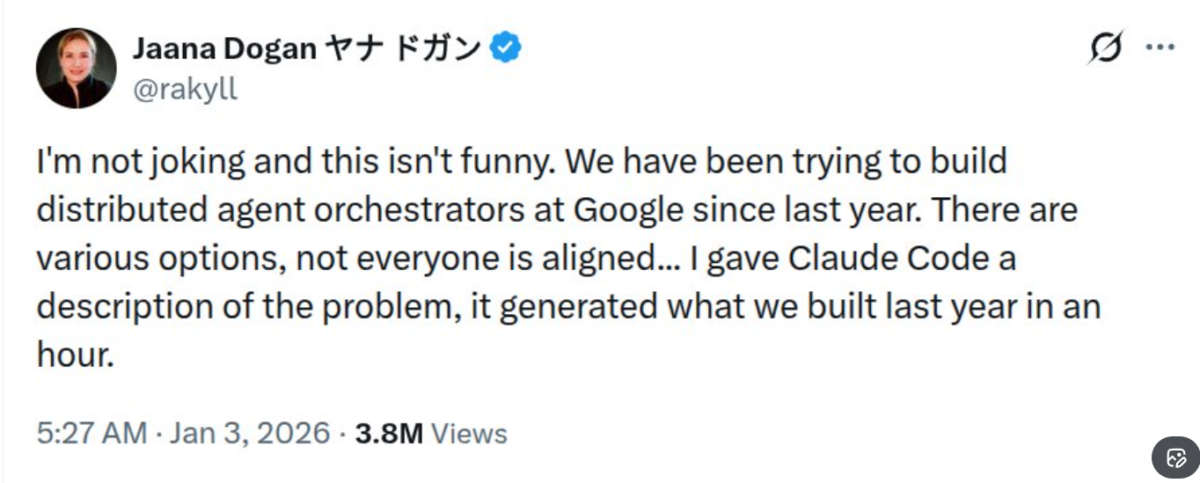
She gave it a simple three-paragraph description of what they were trying to build. The AI tool generated a working system that matched the core of what Google had been developing for 12 months. “I’m not joking and this isn’t funny,” she wrote, clearly surprised by the results.
The post has already crossed 5 million views, and it’s easy to understand why. This isn’t coming from just any developer Dogan works on the Gemini API team. That’s Google’s own AI product. So when she publicly praises a competitor’s tool, people pay attention.
The Real Story Behind the Speed
Here’s what makes this interesting. Dogan explained that the solution Claude Code created wasn’t perfect or production-ready. She called it a “toy version” that would still need work before going live. But the tool got the architecture right. It understood the design patterns and made the right structural choices without needing detailed instructions.
What really slowed down Google’s team wasn’t the coding itself. It was the internal discussions. Different teams wanted different approaches. Getting everyone to agree took time. Claude Code just skipped all of that and delivered based on a clear problem statement.
When someone asked if Google employees use Claude Code for internal projects, Dogan confirmed they only use it for open-source work. For internal systems, Google wants its engineers working with Gemini. But the fact that she even tested it and then talked about it publicly shows how competitive things are getting.
Why This Matters More Than You Think
Dogan handled the whole situation professionally. She said the tech industry has never been zero-sum, so it’s fine to give credit where it’s due. “Claude Code is impressive work,” she added. “I’m excited and more motivated to push us all forward.”
She also shared how fast AI coding tools have evolved. In 2022, these tools could only complete single lines of code. By 2024, they were handling multiple files at once. Now in 2026, they’re restructuring entire codebases. She admitted she thought this level of capability was still five years away back in 2023.
The timing matters because we’re seeing similar stories across the industry. Boris Cherny, who created Claude Code, recently said he’s landed 259 pull requests in the past month all written by Claude Code. Anthropic’s CEO mentioned that 90% of their company’s code is now AI-generated. Even Google reported that 50% of their code comes from AI assistance.
The Part Everyone’s Missing
Here’s what I think is the real story, and it’s something most coverage is overlooking. This isn’t about AI being “better” than human developers. It’s about AI removing the obstacles that slow down smart people who already know what they’re doing.
Dogan had the expertise. She knew what needed to be built. She understood the architecture. What she didn’t have was a year to wait while internal teams debated the best approach. Claude Code gave her a working starting point in an hour. From there, she could apply her domain knowledge to refine and improve it.
That’s the shift happening right now. The bottleneck in software development isn’t always the coding it’s the coordination, the meetings, the alignment discussions. AI tools like Claude Code are starting to cut through that friction. They take a clear description and execute it, letting experienced developers focus on the strategic decisions and refinements.
For developers watching this story unfold, the message is clear. These tools aren’t replacing your job they’re changing how fast you can move from idea to implementation. And if engineers at Google are finding them valuable enough to mention publicly, that’s probably a signal worth paying attention to.

Cody Scott
Cody Scott is a passionate content writer at AISEOToolsHub and an AI News Expert, dedicated to exploring the latest advancements in artificial intelligence. He specializes in providing up-to-date insights on new AI tools and technologies while sharing his personal experiences and practical tips for leveraging AI in content creation and digital marketing