
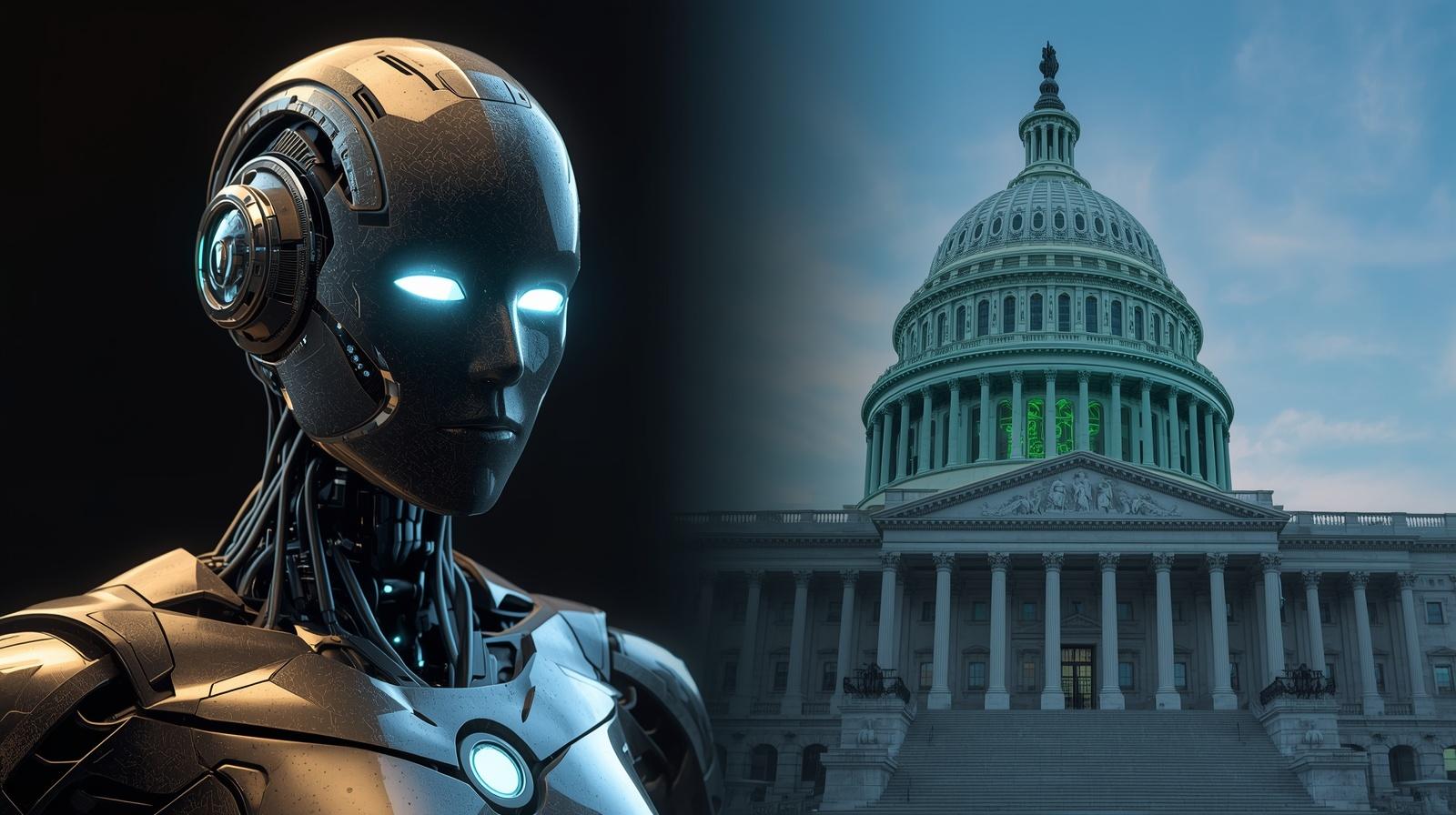
Somewhere in a government building right now, lawmakers are writing a law to make absolutely sure your AI assistant can never own property, sign a contract, or sue you in court. That sounds like science fiction. It’s not. It’s happening right now — in multiple US states at the same time — and the speed at which it’s moving says more about where AI is headed than almost any product launch this year.
What Is the AI Non-Sentience and Responsibility Act
This isn’t one bill in one place. It’s a wave.
HB 1746 and SB 1474 — introduced in the same legislative session by Rep. Miller and Sen. Nicola — formally create what’s being called the AI Non-Sentience and Responsibility Act. In plain language, the bill does one thing: it permanently and legally declares that no AI system can ever be recognised as a legal person under any circumstances.
Simultaneously, Ohio’s HB 469, sponsored by Rep. Claggett, would formally declare AI systems “nonsentient” under state law and strip any future pathway to legal personhood before it can even be argued in court. Multiple other states — including legislatures in the South and Midwest — have near-identical bills sitting in committee right now, all moving at the same time.
This isn’t coincidence. This is a coordinated political response to something that’s quietly been building in legal and academic circles for over two years.
Why Are Lawmakers Suddenly So Worried About This
Here’s the backstory most articles aren’t explaining clearly enough.
Legal personhood in the US doesn’t mean being human. Corporations are legal persons. Rivers in some countries have been granted legal personhood. The legal concept has always been about the ability to hold rights, own assets, enter contracts, and be held liable — not about biology.
As AI systems have become capable of independently managing finances, making business decisions, drafting legal documents, and operating autonomously for extended periods — legal scholars started asking a question that made courts very uncomfortable: at what point does an AI agent need legal status to function properly?
Some AI startups have already explored structuring their autonomous AI agents as LLC operators — entities that technically act as independent economic participants. That’s not theoretical anymore. It’s been tested in court filings. And it scared enough legislators into action that 50 state lawmakers from both parties signed a letter urging preemptive federal legislation before any court could set a precedent the other way.
What the Bill Actually Bans — And What It Doesn’t
This is where it gets nuanced and where most coverage gets it wrong.
The AI Non-Sentience and Responsibility Act does not ban AI from being powerful, autonomous, or commercially valuable. ChatGPT, Gemini, Claude — all completely unaffected in terms of what they can do for you. The bill specifically targets legal standing — the ability of an AI to be a party in a lawsuit, to own intellectual property in its own name, or to enter binding agreements independently.
What this means in practice:
- An AI cannot be sued directly — only the company that built or deployed it can
- An AI cannot own patents filed under its own name — the human or company behind it must own them
- An AI cannot sign a contract — a human or legal entity must always be the contracting party
- An AI cannot inherit assets, hold bank accounts, or make legal claims independently
For most everyday users, none of this changes anything today. But for the future of autonomous AI agents — systems that are being designed right now to operate businesses, manage investments, and run supply chains without human intervention — this is a hard legal ceiling being bolted into place.
My Opinion on This — This Law Is Less About AI and More About Fear
I’ll be honest — when I first read through these bills, my instinct was to call this performative politics. Lawmakers banning something that doesn’t exist yet to look like they’re doing something about AI.
But the more I looked into it, the more I think this is actually one of the more rational things Congress has done in the AI space this year.
Here’s why. The AI industry’s trajectory over the next 24 months is pointing directly at fully autonomous AI agents — systems that don’t just answer questions but independently conduct research, manage workflows, execute trades, draft and send communications, and operate with minimal human oversight. OpenAI’s own roadmap has agents as its primary focus. Anthropic’s Claude for Business is already being deployed in semi-autonomous enterprise workflows. Google’s Gemini agents are being tested in supply chain management at Fortune 500 companies.
The legal infrastructure for that world doesn’t exist yet. And in the absence of clear law, courts make precedent. Precedent is messy, unpredictable, and hard to undo.
What these bills are doing — clumsily, imperfectly, but genuinely — is drawing a line before a court draws it for them. And honestly? I’d rather have an elected legislature make that call than a single federal judge in a case nobody was paying attention to.
The part that actually concerns me is different. By declaring AI systems legally nonsentient and removing any future pathway to legal personhood, these bills also permanently shift all legal liability onto developers and deployers — forever, regardless of how capable these systems become. That might sound great right now. In ten years, when AI systems are genuinely operating with a level of autonomy we can barely imagine today, it creates a liability framework that could cripple innovation entirely.
We’re drawing permanent lines based on where AI is today. But this law will live in a world where AI is something completely different.
What Happens Next
The bills are currently in committee in multiple states. A federal version — likely rolled into the broader TRUMP AMERICA AI Act introduced by Sen. Marsha Blackburn on March 18 — is expected to be debated in Congress before the end of Q2 2026. If federal legislation passes, it would override all state-level versions and create a single national standard.
For you as an everyday AI user, nothing changes today. But if you’re a developer building autonomous AI agents, an investor funding AI startups, or a lawyer who works in tech — this is the legislation you need to be watching most closely right now.

Cody Scott
Cody Scott is a passionate content writer at AISEOToolsHub and an AI News Expert, dedicated to exploring the latest advancements in artificial intelligence. He specializes in providing up-to-date insights on new AI tools and technologies while sharing his personal experiences and practical tips for leveraging AI in content creation and digital marketing